Rasteno Pest ProtectionRasteno Pest Protection

Bed Bug Heat and Chemical Remediation Denver

Structural bed bug eradication in Denver requires adjusting methodology based on architectural framing and elevation dynamics. In older multi-family brick structures common to Capitol Hill, Five Points, and Baker, bed…
Get My Free Estimate →(720) 973-3817
Bed Bug Heat and Chemical Remediation in Denver, CO
Quick answer
  • What is included: Full perimeter inspection, structural heat elevation to 122°F, 135°F, and targeted residual chemical barrier application.
  • How fast: Thermal treatments require 6 to 8 hours for a single residence; inspections are scheduled within 24 to 48 hours.
  • What it costs: Ballpark pricing ranges from $300 for localized chemical containment up to $2,500 for whole-home thermal remediation, with exact pricing confirmed after an on-site evaluation.
  • Targeted pests: Adults, nymphs, and eggs of the common bed bug (*Cimex lectularius*) hidden in mattresses, baseboards, and wall voids.
  • How to schedule: Arrange an inspection by calling (720) 973-3817.

Structural bed bug eradication in Denver requires adjusting methodology based on architectural framing and elevation dynamics. In older multi-family brick structures common to Capitol Hill, Five Points, and Baker, bed bugs migrate easily through shared radiator lines, electrical conduits, and shared lath-and-plaster walls. A pure chemical surface spray often fails because Cimex lectularius develops resistance to standard pyrethroids, while the low relative humidity of the Denver metro basin accelerates chemical desiccation on porous wood surfaces. Combining thermal convection heating with targeted liquid residual applications prevents escape into adjacent units while securing long-term prevention.

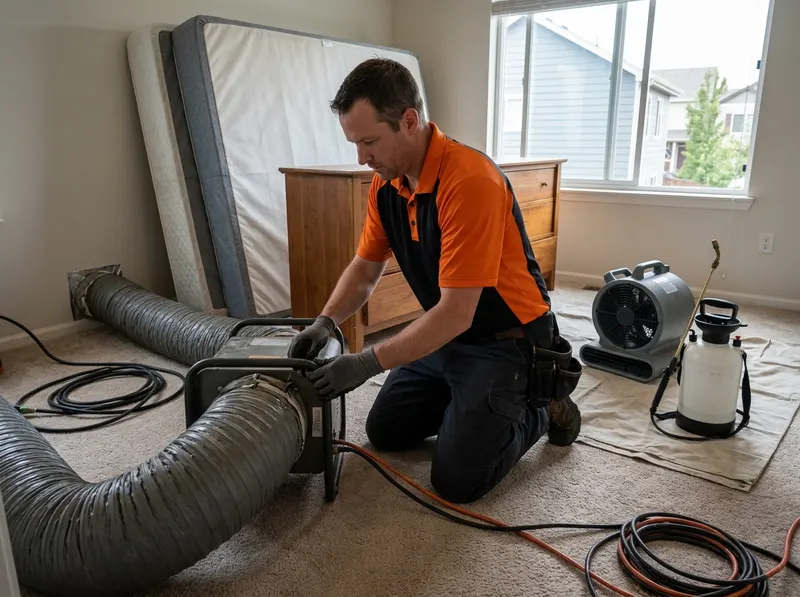
Thermal remediation utilizes industrial electric heaters and axial air movers to circulate air heated between 122°F and 135°F throughout the living space. According to entomological thermal death curves, adult bed bugs and their eggs denature and die within 90 minutes when ambient structural temperatures reach 118°F. Maintaining the 122°F threshold for a minimum of 4 sustained hours ensures convective heat reaches through dense hardwood floors, mattress cores, and deep drywall tracks found in historic homes across Montclair and Park Hill. This eliminates the viable egg stage, which traditional contact sprays miss.

Decision guidance depends on clutter density and building construction. For a detached single-family home in Sloan's Lake or Washington Park, whole-home thermal treatment offers a single-day resolution without discarding upholstered furniture, though heat-sensitive items such as wax, vinyl records, and pressurized canisters must be removed beforehand. For modern high-density multi-story units near Highland or Cherry Creek, a hybrid protocol matches localized heat containment with an insect growth regulator (IGR) barrier along baseboards to intercept any nymphs emerging from base structural voids. Treatment paths are sequenced systematically: 1. Visual and acoustic inspection of seam lines and headboards; 2. Preparation of heat barriers and sensitive item staging; 3. Thermal run cycle with infrared monitoring; 4. Perimeter micro-injection of non-repellent residual chemistry along baseboards.

Bed Bug Heat and Chemical Remediation cost in Denver

Single-Room Targeted Chemical Treatment$300, $450
Multi-Room Hybrid (Localized Heat + Residual)$650, $1,200
Whole-Home Thermal Remediation (Up to 2,000 sq ft)$1,400, $2,500
Post-Treatment Verification & Barrier Renewal$300, $400

Every job gets a firm, written price after a free on-site visit.

Common questions

How much does bed bug remediation cost in Denver?
Bed bug remediation in Denver starts at a $300 minimum for targeted chemical containment, while comprehensive whole-home thermal heat treatments generally range between $1,400 and $2,500 depending on total square footage and property layout.
How should a Denver home be prepared before thermal bed bug treatment?
Preparation requires removing pressurized cans, candles, crayons, vinyl blinds, oil paintings, and live plants from the treatment zone, while leaving clothing and bedding loosely unstacked inside closets so heated air can circulate at 122°F.
Do bed bugs travel between apartments in Denver multi-family buildings?
Bed bugs travel easily through wall cavities, plumbing chases, and electrical wiring in Denver multi-family properties, making perimeter residual applications along common walls necessary to stop dispersal during heat application.
How long must residents leave a Denver home during bed bug heat treatment?
Residents, pets, and heat-sensitive items must stay out of the Denver property for 6 to 8 hours while the structural heat cycle runs, plus an additional 1 to 2 hours for indoor ambient temperatures to return below 85°F.
Are chemical treatments alone sufficient to eradicate bed bugs in Denver?
Chemical treatments alone require multiple visits spaced 14 days apart to catch newly hatched nymphs, whereas combining high-heat thermal convection with non-repellent chemicals destroys eggs and active insects during the initial remediation.
Helpful resources

Trusted references & local links

USA.gov, government & consumer helpBetter Business BureauFTC Consumer AdviceU.S. Small Business AdministrationReady.govU.S. EPAENERGY STARU.S. Dept. of EnergyConsumer.govU.S. Census BureauGoogle Maps, Denver, CO

Get started today

Tell us about your bed bug heat and chemical remediation job in Denver and we'll send a clear, written quote, usually the same day.

Get your free PEST CONTROL SERVICE quote, Denver

We only use your ZIP to check availability, no spam.