Rasteno Pest ProtectionRasteno Pest Protection

Subterranean Termite Treatment and Monitoring Denver

Denver sits in a moderate-to-heavy subterranean termite pressure zone along the Front Range, where eastern subterranean termites travel through moisture-seeking underground networks beneath the frost line. In historic…
Get My Free Estimate →(720) 973-3817
Subterranean Termite Treatment and Monitoring in Denver, CO
Quick answer
  • What is included: 360-degree foundation inspection, structural wood probing, installation of exterior bait monitoring stations every 10 to 15 linear feet, or non-repellent liquid soil trenching.
  • Turnaround time: Initial perimeter inspections take 60 to 90 minutes, with complete barrier installation or monitoring station placement completed within 1 business day.
  • Cost structure: Targeted treatments and comprehensive station installations range between $300 and $2,400 depending on linear foundation footage, with a strict $300 minimum inspection and localized treatment charge.
  • Targeted pests: Eastern subterranean termites (Reticulitermes flavipes) and arid subterranean termites (Reticulitermes tibialis), addressing both worker galleries and reproductive swarmers.
  • Scheduling: Inspections and station checks operate Monday through Saturday across all Denver County ZIP codes by calling (720) 973-3817.

Denver sits in a moderate-to-heavy subterranean termite pressure zone along the Front Range, where eastern subterranean termites travel through moisture-seeking underground networks beneath the frost line. In historic brick bungalows across Baker and Capitol Hill, colonies exploit sandstone footings and sub-grade mortar cracks to access structural floor joists. Modern slab-on-grade developments near Sloan's Lake and Central Park experience intrusion through expansion joints, plumbing penetrations, and perimeter sill plates. Because subterranean termites require soil contact for survival, treatment requires addressing the sub-grade colony rather than superficial wood spraying.

Protective intervention relies on two distinct structural paths: non-repellent liquid barrier soil treatments and continuous in-ground bait monitoring networks. A liquid termiticide barrier creates an uninterrupted treated soil envelope around the entire foundation trench, binding to Denver's expansive bentonite clay soils to eradicate foraging workers. Continuous monitoring stations, positioned 2 to 4 feet off exterior foundation walls in landscape beds across Washington Park and Montclair, utilize cellulose matrices laced with insect growth regulators. Foraging workers ingest the matrix, return to the subterranean nest, and eliminate the reproductive queen through trophallaxis without disrupting indoor living quarters.

1. Structural diagnostic inspection: The technician inspects accessible foundation walls, crawl spaces, rim joists, and floor plates with high-output illumination and moisture meters to verify mud tubes and wood hollowness.

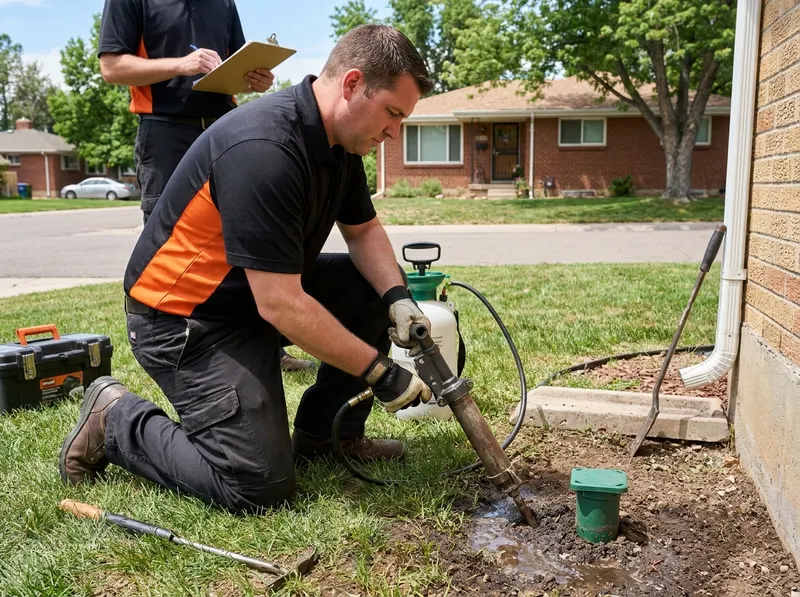
2. Perimeter preparation: Trenching or core drilling through exterior concrete walkways occurs along the exterior perimeter, spacing injection points or stations 10 to 15 feet apart.

3. Material application: Non-repellent liquid termiticide is pumped at 4 gallons per 10 linear feet per foot of depth, or baited stations are locked into the native soil.

4. Documentation and structural tracking: Technicians log station GPS coordinates, establish baseline wood consumption markers, and schedule biannual monitoring checks.

Homeowners weighing comprehensive liquid barriers against continuous bait networks navigate a balance between immediate perimeter saturation and minimal landscape disruption. Liquid applications establish an immediate treated zone around Park Hill foundations, yet require drilling concrete patios and digging 6-inch trenches through turf. In-ground bait monitoring leaves mature gardens in Cherry Creek and Highland undisturbed and continuously suppresses colony pressure over multiple seasons, but relies on worker discovery intervals that require 60 to 90 days to achieve full structural colony elimination.

Subterranean Termite Treatment and Monitoring cost in Denver

Comprehensive Subterranean Termite Diagnostic Inspection$300 to $450
Localized Spot Termiticide Injection (under 20 linear feet)$300 to $650
Full Perimeter Bait Monitoring Station Network (Standard Denver Lot)$850 to $1,600
Complete Liquid Barrier Foundation Trenching and Soil Injection$1,400 to $2,400
Annual Station Inspection, Re-Baiting, and Structural Warranty Renewal$300 to $480

Every job gets a firm, written price after a free on-site visit.

Common questions

What causes subterranean termite infestations in Denver homes?
Denver subterranean termites nest underground below the 36-inch regional frost line, moving upward through foundation fractures, expansion joints, and wooden porch supports in search of structural cellulose and domestic moisture sources.
How does bentonite clay soil affect termite treatment in Denver?
Expansive bentonite clay across Denver County expands during spring rains and shrinks during dry summers, creating foundation shifting and deep subterranean fissures that allow termites direct access beneath concrete basement slabs.
What is the minimum cost for subterranean termite services in Denver?
The minimum charge for professional subterranean termite diagnostic assessments or localized treatments in Denver is $300, with exact perimeter costs confirmed during the on-site physical inspection.
How do bait monitoring stations differ from liquid barrier treatments in Denver?
Bait monitoring stations use tamper-resistant in-ground cylinders to distribute growth regulators back to the subterranean nest without excavating soil, whereas liquid barriers saturate the perimeter earth to stop entry immediately.
How often should Denver homeowners inspect foundation bait stations?
In-ground monitoring stations installed on Denver properties require physical checks every 6 to 12 months to measure bait consumption, replace degraded wood matrices, and verify zero perimeter mud-tube activity.
Helpful resources

Trusted references & local links

USA.gov, government & consumer helpBetter Business BureauFTC Consumer AdviceU.S. Small Business AdministrationReady.govU.S. EPAENERGY STARU.S. Dept. of EnergyConsumer.govU.S. Census BureauGoogle Maps, Denver, CO

Get started today

Tell us about your subterranean termite treatment and monitoring job in Denver and we'll send a clear, written quote, usually the same day.

Get your free PEST CONTROL SERVICE quote, Denver

We only use your ZIP to check availability, no spam.