Denver rodent activity surges sharply in October and November when Front Range overnight temperatures drop below freezing, driving rodents indoors from nearby open corridors like City Park, Cheesman Park, and the South…
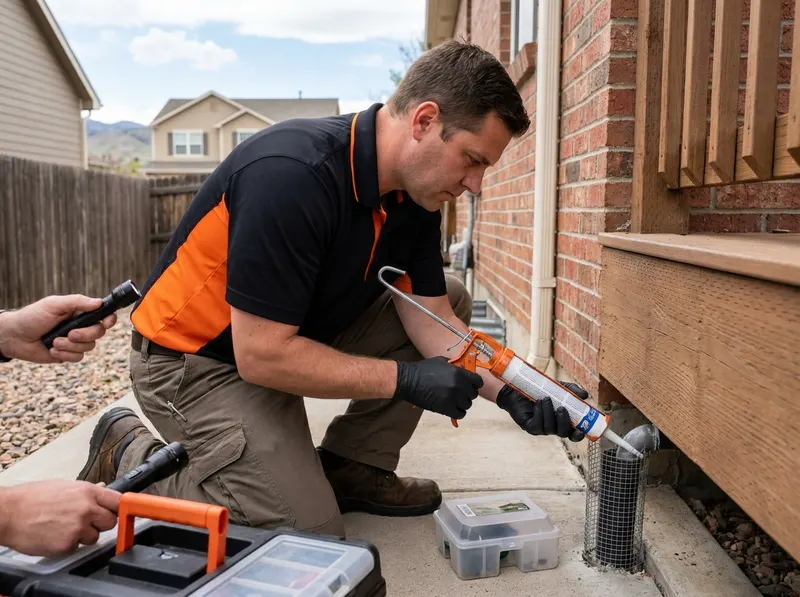
Denver rodent activity surges sharply in October and November when Front Range overnight temperatures drop below freezing, driving rodents indoors from nearby open corridors like City Park, Cheesman Park, and the South Platte River trail. House mice need a gap of just one-quarter inch, roughly the diameter of a standard pencil, to squeeze beneath exterior thresholds, sill plates, and deteriorated mortar joints. In historic brick bungalows across Baker, Washington Park, and Park Hill, rodents exploit foundation settlement cracks, uncapped crawl space vents, and utility wall penetrations behind HVAC and plumbing lines. In newer multi-story builds and remodeled Victorians in Highland, Five Points, and Sloan's Lake, mice often bypass lower floors entirely, entering via roof overhangs, unsealed soffit vents, and weep holes before nesting in warm subfloor insulation.
A complete pest exclusion plan relies on physical barriers rather than ongoing chemical applications. Standard sprays fail against rodents, and over-the-counter poisons deployed inside living quarters risk secondary poisoning of household pets or carcasses decaying inside wall voids. Proper eradication begins by identifying entry points along stone masonry, crawl spaces, and garage door weatherstripping. Technicians fit 16-gauge galvanized steel hardware cloth, copper wire mesh, and elastomeric structural sealants to block air-draft scents that attract migrating rodents. Mechanical snap traps set along confirmed interior travel runways capture the trapped population without placing rodenticides inside the home.
Selecting between localized trap maintenance and complete structural exclusion depends on home construction age and property permanence. For tenants or short-term property holders, setting interior snap traps and perimeter bait stations provides temporary population suppression, but it leaves open entry points vulnerable to reinvasion during the next cold front. For long-term single-family homeowners in Montclair and Cherry Creek, structural exclusion provides permanent protection. Sealing entry points stops new mice from entering, ending recurring exterminator dispatch fees. Heavily infested crawl spaces or attics with compressed fiberglass and rodent droppings require localized sanitation and barrier placement to restore safe indoor air quality.
Every job gets a firm, written price after a free on-site visit.
Tell us about your mice removal and rodent exclusion job in Denver and we'll send a clear, written quote, usually the same day.
 Rasteno Pest Protection