Stinging insect activity in Denver County escalates rapidly between late June and October, driven by semi-arid Front Range climatic patterns that force social wasps into residential areas for water and sugar sources.…
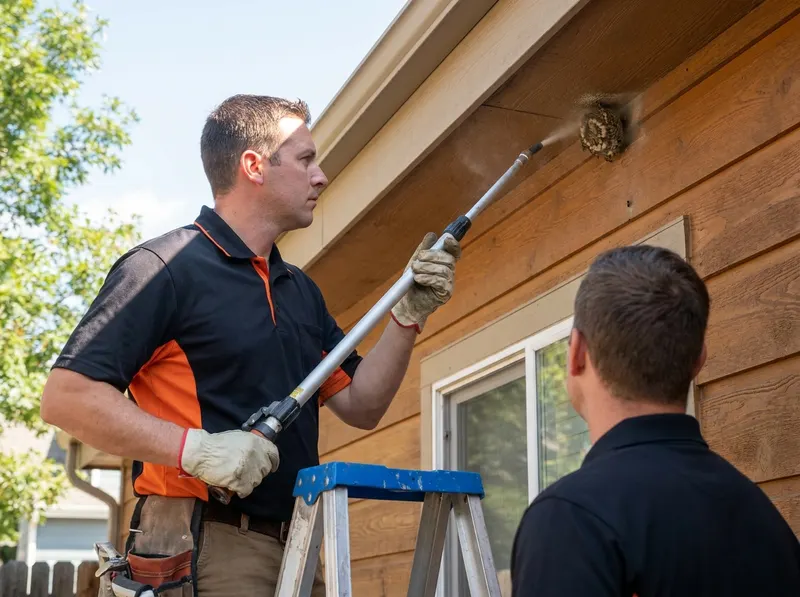
Stinging insect activity in Denver County escalates rapidly between late June and October, driven by semi-arid Front Range climatic patterns that force social wasps into residential areas for water and sugar sources. In historic neighborhoods like Capitol Hill, Baker, and Montclair, mature architecture with ornamental soffits, uncapped brick chimneys, and open rafter tails provides prime harborage for Western yellowjackets and European paper wasps. Modern builds in Sloan's Lake, Highland, and Five Points frequently experience aerial nesting under expansive flat-roof fascias, composite decking, and metal gutters. Left unaddressed, forage workers defend territorial perimeters aggressively, posing immediate biological hazards to households, domestic pets, and pedestrians along public sidewalks.
Eradication strategy depends directly on the biological nesting site of the target species. A hanging paper wasp nest under a porch eave in Washington Park requires aerosolized knockdown contact agents paired with mechanical detachment and scraping of the anchoring pedicle. Conversely, subterranean yellowjacket nests excavated in landscaped turf near Cheesman Park or void-nesting yellowjackets inside exterior brick veneer in Cherry Creek demand pressurized micro-dust injections that penetrate the deep gallery without driving aggressive workers through indoor drywall joints into interior living spaces. The fundamental trade-off lies in immediate topical eradication versus systematic void penetration: surface spraying an exterior entry hole often causes colony displacement inward, whereas deep-void dusting safely collapses the entire reproductive brood at the source.
Structural exclusion is the definitive barrier against seasonal re-infestation in Denver properties. Following active colony neutralization, technician protocols include mapping vulnerability sectors such as detached garage eaves, loose siding laps along alleyways, and unscreened foundation vents. Sealing entry points with copper mesh, silicone-based sealants, and elastomeric caulk prevents prospective queens emerging from winter diapause in Park Hill attics from re-establishing colonies in the identical framing voids the following spring. Direct phone scheduling and dispatch are available at (720) 973-3817.
Every job gets a firm, written price after a free on-site visit.
Tell us about your wasp and stinging insect removal job in Denver and we'll send a clear, written quote, usually the same day.
 Rasteno Pest Protection